Showing posts with label language. Show all posts

Tuesday, June 16, 2015

Myth: Chinese is a Single Language

Numerous individuals invest years learning outside dialects, a procedure that is troublesome yet in any case remunerating. Yet, there are some odd ideas out there about the dialects of the world.


A great many people expect that Chinese is a solitary, solid dialect talked by more than 1.3 billion individuals. Others may have the capacity to recognize Mandarin and Cantonese, because of the social impact of Hong Kong film. In reality, the Chinese government serves to propel this thought, distinguishing Mandarin as the standard dialect and everything else talked as simple vernaculars.

In actuality, on the other hand, there are many diverse dialects talked in China, which vary more from the standard Mandarin than distinctive European dialects do from each other. The biggest non-Mandarin tongue is Wu, talked in Shanghai and the areas of Zhejiang, Jiangsu, Anhui, Jiangxi, and Fujian. This vernacular is for the most part called Shanghainese, while etymologists call it Wu after the old kingdom of Wuyue. Different speakers of Chinese think of it as a delicate and streaming dialect, however are frequently put off by Shanghai people groups' refusal to communicate in Mandarin. Cantonese, talked in some parts of China, is a nasal dialect with long vowels and nine tones and is considered to have saved various elements from the Classical Chinese dialect. Tang line verse regularly rhymes when talked in Cantonese, however once in a while in Mandarin.


Different dialects still utilized by millions as a part of China incorporate Hokkien, Jin, Hunanese, Hakka, and Gan. In the mid 20th century, Shanghai scholarly people pushed for a solitary national dialect so as to encourage correspondence over the unlimited nation. This reverse discharges on them, as the boundless and generally simple Mandarin dialect was picked, which prompted the efficient restraint of every single other type of Chinese. Then again, these dialects are still talked by a great many individuals in China and via abroad Chinese groups far and wide.


Lost And Found

The thought of an invaluable fortune lost to humankind is so inalienably sentimental, its fueled four Indiana Jones films and about twelve Listverse articles. Nothing could be cooler for the majority of us than revealing a missing relic, regardless of how unimaginable that may be.Or is it? In the most recent couple of years alone, scholastics, history specialists, and customary Joes have sufficiently discovered lost fortunes to fill a whole gallery.
From time to time in mankind's history, something is rediscovered that could possibly change the world. One case is when researchers rediscovered the works of the Greeks and Romans, introducing the Renaissance. Another could be the disclosure of the Tsinghua Bamboo Slips. 
A gathering of antiquated bamboo pieces secured in Chinese characters, the slips contain a portion of the most punctual Chinese compositions ever uncovered. Alongside two comparable pulls going back to 1993, they appear to speak to a school of Eastern writing and science totally overlooked by the world. Maybe in particular, they originate before the first Qin ruler by almost a century. In 213 BC, the ruler requested all books to be blazed and researchers to be killed. The outcome was a terrific loss of information and society, as a great many basic writings went up in smoke. Quick forward to today, and we may be at last recovering some of them. 

As of now, investigation of the three original copy pulls has uncovered the soonest known form of the I Ching, new messages by Confucius, and a model variant of the Taoist Book of the Way, with significant contrasts from later versions. It's likewise revealed the most seasoned utilization of a decimal increase table ever. With its numerous fortunes just now beginning to advance into open awareness, its even been recommended we might soon see a wholesale revamping of Chinese social history. Not awful for a pack of mildew covered, old bamboo strips.

Thursday, June 4, 2015

Five Common English Idioms

Continuously a bridesmaid, never a lady 
Meaning: Literally, continually being a bridesmaid and never a lady. All the more allegorically, it is a sad saying for ladies when they can't discover affection.

Creation: This jewel of an expression was initially recorded in a Victorian music lobby tune, "Why Am I Always A Bridesmaid?", by Fred W. Leigh. In any case, the expression accumulated fame after a reflectively amusing commercial for Listerine mouthwash in 1924. The motto, "Frequently a bridesmaid, yet never a lady", went hand in hand with a photo of a miserable 'Edna', who, due to her halitosis (terrible breath), was never having the capacity to discover affection. The arrangement: purchasing Listerine mouthwash in mass.


Pull someone's legs
Meaning: Joking or tricking with somebody.

Creation: To draw somebody's leg had significantly more vile hints when it first came being used. It was initially a strategy utilized by cheats to ensnare their people on foot and in this manner victimize them. One hoodlum would be relegated 'tripper up' obligation, and would utilize distinctive instruments to thump the individual to the ground. Fortunately, nowadays the adage is a great deal more friendlier, however being on the end of a joke may not generally be enjoyable.

Meeting a due date 
Meaning: To get done with something by a foreordained time.

Creation: This adage clearly originates from the jail camps amid the Civil War, where a line was attracted to delineate the limits for the detainees. The line got to be to be known as a due date in light of the fact that any detainee who endeavored to cross it was shot.

Basket Case
Meaning: Someone who is unhinged.

Creation: According to undetermined reports, WW1 fighters who had lost every one of their appendages were conveyed in wicker container. The genuine term, 'bundle of nerves', however was instituted by the US military – willfully ignorant of this practice – after WW1. In 1919, a release was issued by the U.S. Order on Public Informant.


Wednesday, May 13, 2015

How do Animals Communicate?

Animals do not speak like humans do but they have their own kind of communication. Examples are peacocks using their beautiful tail to gain attention from female peacocks as well as fireflies. Communication can also through making sounds like how wolves howl during the night to call the other members of its pack.  In other words, animals can communication non-verbal and verbal. Non-verbal is when they use their body to do actions like how dogs wag their tails.

Like humans, animals have also different kinds of dialects. One good examples are the birds. Sometimes, they can even use the dialect of another species to be able to communicate them.
Communication is also very important to animals. It will help them to find each other, to survive or to even reproduce. Sometimes, they use it to portray emotions. However, this can be altered because of the great noise pollution we have right now. Cities have busy people, talking and shouting. Roads are filled with noisy engines and honking. Some has too loud music. This decreases their ability to successfully communicate with each other. Some has to adapt to the sudden change.


There are also weird ways of animal communication. Have you seen Prairie dogs in real life? Prairie dogs are a different kind of squirrel that lives under the hot grounds of the deserts. They also have a little village there. Their communication is through very noisy barks and yips. However, if you happen to pass by a group of these animals and they start making noises, they are surely talking about you already. Through their “barking” they can be able to UNIQUELY describe a person’s appearance, smell and clothing. To sum it up, they were able to over rank dolphins and chipmunks when it comes to the advancement of animal communication and language. 


Thursday, March 5, 2015

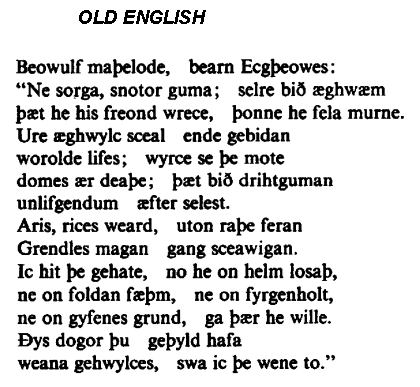
The Three Periods of English

Language is very important for people to understand each other. The universal language is the English Language. A lot of people used this all over the world. But how exactly how the English Language originated and became to be the right now. 
Old English (499-1100)
The English during this period is also called as the Anglo-Saxon. The Roman soldiers were the one who introduced Christianity to England. This is how they were able to get the Christian words like altar, candle, organ, school and master. The second influence was by the Danes who invaded next. They were able to know egg, sky, skin, law, get and give. However, they did not change its grammar but instead, the pronunciation and the vocabulary. 

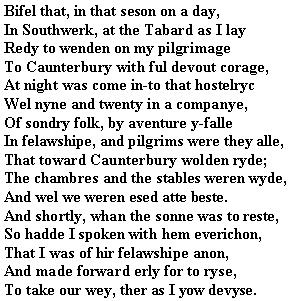
Middle English (1100-1500)
English changed greatly when the French invaded England. There were useful words like city, court, fruit, flower, soldier and beauty. The names of the meat also changed. From cow or ox , they became beef. Pig and hog became pork. French became the language of the court. However, it rose again until 1362 it was the official language of the courts of the law and soon became the also the medium in schools. The first books became more focused on their grammar and even spelling. 

Modern English (1500-present)
There are now few changes in the language especially the larger number of words and even changes in the pronunciation. Nowadays, we used foreign words and added them to the vocabulary like kindergarten (German), garage (French), piano (Italian), ranch (Spanish), tank (Portuguese) and wigwam (American Indian). Also, there were a lot of men who were great in literature. To name a few, Shakespeare, Milton, Dryden and Shelley. Today, English is a language of simple grammar, wide vocabulary and a lot of beautiful arrangements of sentences.